Is the hardest part of a DeFi transaction really signing it, or is it understanding what you are being asked to sign? For a US user moving between Ethereum, Arbitrum, Polygon, or another supported network, the practical problem is rarely just access to a wallet. It is coordination: selecting the correct network, identifying the real asset, approving token permissions, estimating fees, and judging whether a swap route is sensible. Rabby Wallet was built around that decision-making problem rather than treating a wallet as a simple key container.
That distinction matters. A browser wallet can hold keys and connect to decentralized applications, but its safety value depends on how clearly it presents transaction consequences. Rabby’s appeal lies in combining wallet functions with transaction simulation, network-aware prompts, and tools for interacting across multiple chains. Those features do not eliminate smart-contract risk or make a bad trade good. They can, however, improve the user’s information before a transaction becomes irreversible.
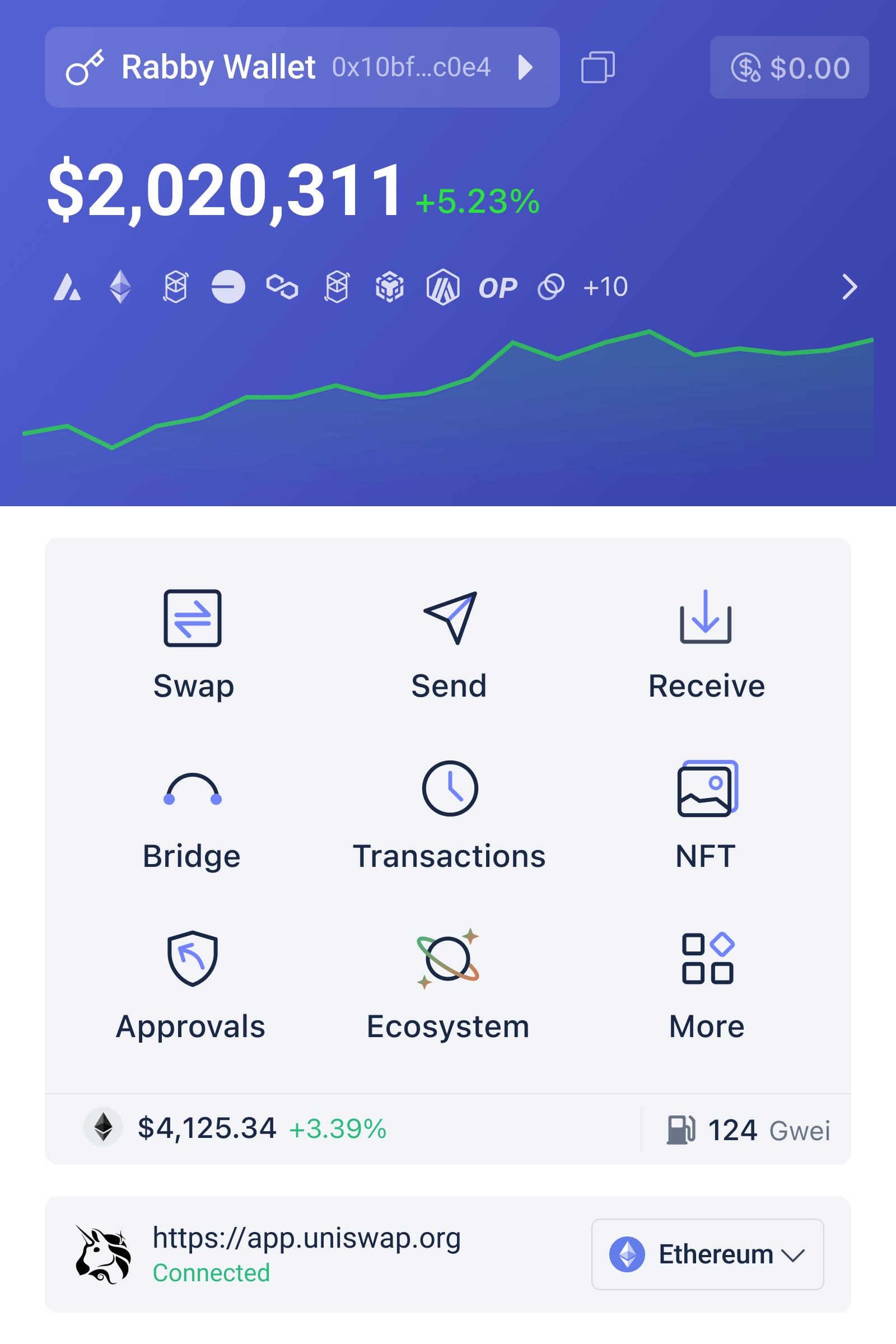
From single-chain wallets to transaction context
Early cryptocurrency wallets were often understood as digital equivalents of a bank account: a place to store balances and send funds. DeFi made that model incomplete. A wallet became an interface to lending markets, decentralized exchanges, bridges, staking systems, and governance contracts. Each interaction introduced a different combination of approvals, fees, contract permissions, and execution conditions.
The historical shift is important because “multi-chain” does not merely mean displaying several balances in one window. Each blockchain has its own state, fee market, transaction format, contract ecosystem, and sometimes a different version of the same token. A user who sees an asset called USDC on two networks may be looking at assets with similar economic purposes but different contract addresses and liquidity environments. The interface must therefore help answer a more precise question: what exactly will happen on which network, using which contract, and under what assumptions?
Rabby’s design addresses this through a risk-oriented interface. Before signing, users may be shown the expected balance changes, the assets involved, and warnings associated with the transaction. This is more than cosmetic convenience. In security research, informed consent depends on the user receiving information that is both relevant and comprehensible. A wallet that exposes transaction effects can reduce some forms of blind signing, even though it cannot determine whether the underlying protocol will remain solvent or whether the user’s investment thesis is sound.
A practical case: one cross-chain swap
Consider a user in the United States who holds ether on Ethereum but wants to acquire an asset available more efficiently on Arbitrum. The user might first need to move funds between networks, then swap the asset, then retain enough of the destination network’s native token to pay future fees. A newcomer may describe this as “one swap.” Mechanically, it may be a sequence of separate actions involving a bridge, a decentralized exchange, token approvals, and multiple fee payments.
This is where a cross-chain wallet experience can be misleading if it hides the underlying structure. A cross-chain swap may be implemented through a bridge-and-swap route, a liquidity network, an intent-based system, or a combination of services. The user is not simply moving a token through empty space. A system must coordinate value on different ledgers, rely on liquidity providers or settlement mechanisms, and account for execution conditions such as slippage, liquidity depth, and network congestion.
Rabby can make the workflow easier to inspect, but the user still needs to distinguish convenience from settlement certainty. A displayed route is an execution proposal, not a guarantee. The final amount may change if market prices move, available liquidity shifts, or the transaction takes longer than expected. A helpful heuristic is to evaluate every cross-chain operation along four dimensions: source chain, destination chain, intermediary mechanism, and final asset contract. If any one of those remains unclear, the transaction deserves further investigation before approval.
Why approvals deserve separate attention
Token approvals are a frequent source of confusion. When a decentralized exchange asks permission to spend a token, the approval is usually a contract allowance, not the swap itself. A broad allowance may permit a contract to transfer tokens later, subject to the token’s approval logic. This can improve usability by avoiding repeated confirmations, but it also expands the consequences of interacting with a malicious or compromised contract.
Rabby’s transaction review can help users notice that a transaction contains an approval or another contract interaction. Yet no interface can convert a suspicious protocol into a safe one. Users should still check whether the application domain is authentic, whether the contract address corresponds to the intended service, and whether the requested allowance is proportionate to the action. For a one-time trade, a limited approval may offer a different risk profile from an effectively unlimited allowance.
Downloading and installing the Rabby browser extension
Installation is not a trivial prelude to security; it is part of the security model. The safest process begins with the project’s official distribution path or a carefully verified source, followed by checking that the browser extension is published by the expected developer. Users should be cautious with search advertisements, unsolicited direct messages, cloned websites, and extensions that imitate familiar branding.
Readers who need a starting point for the installation process can review the rabby wallet extension guide, then verify the extension’s publisher and permissions inside the browser before creating or importing a wallet. During setup, a new wallet’s recovery phrase should be generated and stored offline. It should never be entered into a website, sent to support, photographed for convenience, or stored in an unprotected cloud note.
Importing an existing wallet requires even greater care. The recovery phrase is the controlling credential, not a password that can be reset by a company. A browser extension can improve transaction visibility, but it cannot recover funds if the phrase has been exposed. For larger balances, many users may reasonably consider separating daily DeFi activity from long-term holdings, potentially using a hardware wallet where the signing process remains isolated from the browser environment.
What Rabby helps with—and what it cannot solve
The strongest case for Rabby is not that it makes DeFi safe. It is that it can make some risks more legible. Transaction simulation and balance-change previews may help identify an unexpected transfer, a suspicious approval, or a mismatch between the user’s intention and the contract’s apparent effect. Multi-chain organization can also reduce a common operational error: signing on the wrong network or forgetting that fee balances differ by chain.
There are hard boundaries, however. Simulation is conditional on the available blockchain state and the assumptions of the simulation system. A transaction can appear reasonable and still fail later because the market moved, liquidity disappeared, a protocol behaved unexpectedly, or an external dependency was compromised. A warning system may also produce false positives or warnings that users learn to ignore. In security terms, better information reduces some uncertainty; it does not remove adversarial behavior.
Cross-chain activity adds another limitation: risk is compositional. If a route depends on a bridge, an exchange contract, and a token issuer, the overall exposure is influenced by each component and by the connections among them. A familiar interface can make that chain of dependencies feel like one product, even though the underlying trust assumptions remain distributed. This is a non-obvious but important distinction: wallet safety and protocol safety are related, yet they are not the same problem.
A decision framework for everyday DeFi use
Before confirming a transaction, users can ask five practical questions. Am I on the intended network? Is the asset contract the one I meant to use? Is this action a transfer, an approval, a swap, or a bridge operation? What will my balances look like afterward, including the fee token needed for the next action? Finally, which external contracts or services must remain trustworthy for the route to work?
The fifth question often separates experienced practice from interface-driven optimism. A low quoted fee may not represent the full economic cost if the route includes slippage, bridge fees, price impact, or the need to purchase additional gas. Conversely, a route with a slightly higher visible fee may offer deeper liquidity or simpler settlement. The correct comparison is not “cheap versus expensive,” but expected outcome versus total exposure and operational complexity.
For US users, tax reporting can add another layer of practical complexity. Swapping, bridging, and disposing of digital assets may create records that need to be reconstructed later, even when the wallet interface presents the activity as one continuous journey. Rabby is not a tax adviser or a substitute for transaction records. Keeping exports, dates, asset identifiers, and fee information can make later accounting more manageable.
What to watch as wallets evolve
The next phase of wallet design will likely be shaped by a question broader than chain support: can interfaces help users express an intention and then verify whether execution matches it? Intent-based trading, automated routing, and richer simulations could reduce repetitive decisions, but they may also move complexity into systems that are less visible to the user. The trade-off is familiar in computing: abstraction improves usability until hidden assumptions become consequential.
A useful signal to watch is whether wallet warnings become more specific and actionable rather than merely more numerous. Better systems should explain why an interaction is unusual, identify which contract receives permission, distinguish a failed simulation from a dangerous one, and make uncertainty visible. If future tools succeed on those terms, the wallet may become less like a passive key manager and more like a transaction interpreter.
For now, the durable lesson is modest but valuable. Rabby can provide a stronger inspection layer for multi-chain DeFi, especially when users take the time to read transaction effects instead of approving automatically. The browser extension is a tool for improving judgment, not a substitute for it. Cross-chain swaps remain exercises in coordinating liquidity, contracts, networks, and trust. Understanding that structure is the real protection.
Frequently Asked Questions
Is Rabby Wallet a cross-chain bridge?
Rabby is primarily a cryptocurrency wallet and DeFi interface. It may present or support workflows involving multiple networks and cross-chain services, but the actual movement of value depends on the bridge, liquidity system, or protocol used in the transaction. Users should inspect the route rather than assume the wallet itself guarantees settlement.
Does Rabby make DeFi transactions safe?
No wallet can guarantee safety. Rabby may improve transaction visibility through network-aware prompts, simulations, and balance-change information, which can help users identify certain mistakes. It cannot eliminate smart-contract vulnerabilities, phishing, market risk, malicious tokens, bridge failures, or exposure of a recovery phrase.
What should I check before installing the browser extension?
Use a verified distribution source, confirm the publisher, review browser permissions, and avoid links received through unsolicited messages. After installation, protect the recovery phrase offline and never provide it to a website or purported support representative. For significant holdings, consider using a separate wallet or hardware signer for long-term storage.